School Zone Safety: Back-to-School Rules Every Teen Driver Must Know
Street and road conditions in school zones can change quickly. One moment, the road looks routine, but the next, a bus stops, a child steps toward a crosswalk, or a vehicle pulls away from the curb with little warning.
For a new driver still learning to manage speed, space, and mirrors, that combination demands calm attention and early decision-making.
That is why school zone driving rules matter. Drivers need to follow the posted speed limit, watch for active times and flashing signals, yield or stop as required at crosswalks, follow crossing guard directions, and obey their state’s school zone laws.
Knowing the importance of respecting school speed zone rules isn’t only about avoiding a ticket. The real goal is to help your teen recognize hazards sooner, maintain a safe space cushion, and respond with control when the environment changes.
In this guide, you and your teen will learn how common school zone signs, speed limits, crosswalks, and school bus rules work, and how to turn them into calm, confident driving habits.
Why School Zones Can Feel So Intense for New Drivers
School crossing zones often feel intense because they combine familiar roads with a much higher risk and dense pedestrian activity. For a teen, the pavement and lanes look familiar, but the environment is packed with fast-changing hazards: children running late, cars stopping without warning, school buses blocking views, and parents focused on finding their own child instead of watching traffic.
At the same time, your teen is still building basic skills such as judging speed, distance, and braking space.
A school zone is an area around a school, and sometimes along common walking routes, where children are likely to be near or crossing the street. Lower school speed limits give drivers more time and space to recognize a hazard, stop smoothly, and reduce the severity of a potential accident.
You do not need to scare your student driver, but you do want them to understand one core idea: in school zones, they are part of the school safety system. When they slow early, leave space, and drive predictably, they help protect every person near the road, including pedestrians.
At Jungle Driving School, the Jungle Way is a defensive-driving approach built around calm alertness, early hazard recognition, and deliberate space management.
In a school speed zone, that means maintaining a Survival Zone: enough time, visibility, and open space to respond calmly when a child, bicyclist, bus, or vehicle moves unexpectedly.
Utilizing signage and being aware of crossing guards, flashing lights, and other traffic rules enhances safety and minimizes the risk of speeding violations.
How School Zone Signs, Times, and Speed Limits Actually Work
New drivers know school speed zones are “slower,” but they are often uncertain about when the lower limit applies. The safest habit is simple: read the entire sign, watch for active signals, and maintain the required speed until you have clearly exited the zone.
School zone speed limits in the United States are often around 15–25 mph, but overall traffic laws and enforcement conditions vary by city, county, and state. Treat those numbers as general examples, not universal rules.
What matters most is knowing when the lower limit becomes active. Coach your teen to read all school crossing signs properly, and match them to what they see on the street.
Three Common Types of School Zone Signs
Different school zone signs use different triggers, but they all tell your teen the same thing: slow down and pay closer attention.
Once your teen can recognize these three common setups of school zone signs, they will be less likely to guess or miss a change.
- Fixed times: Signs such as “7:00–9:00 a.m. and 2:00–4:00 p.m. on school days” mean the lower limit applies during the times and conditions stated on the sign.
- Yellow flashing beacons: When the lights are flashing, the posted school zone speed limit is generally active. When they are off, another posted limit may apply.
- “When children are present”: The legal meaning of this phrase can vary by location. Follow the definition in your state or local law, and reduce speed whenever children are visible near the road, drop-off zones, crosswalks, buses, or school grounds.
Some areas also post an “End School Zone” sign or a new speed limit sign to mark where the special zone ends. Teach your teen to look for that change so they know when they are truly outside the higher-risk area.
Because traffic laws vary by state, always check your current driver handbook. One rule remains consistent: posted signs and signals control. If a navigation app or vehicle display disagrees with the roadway sign or traffic signal, obey the signs and signals.
When in doubt, slow down and create more time to assess the situation.
Who Has the Right of Way Near School Crosswalks and Bikes?
Right-of-way around a school is not something a teen should try to negotiate aggressively.
The safest mindset is this: protect the path of pedestrians and vulnerable road users, and never force someone to hurry or change direction to avoid the vehicle.
Specific right-of-way laws vary by state, so teens should learn the rules in their local driver handbook.
Crosswalks and Crossing Guards
Around schools, crosswalks are where kids and vehicles physically meet, so drivers should expect to stop early, wait patiently, and move only when the path is clearly open.
Pedestrians in marked crosswalks are generally protected by right-of-way laws, although the exact legal requirements vary by state. Your teen should stop before the stop line and never roll into the crosswalk, even “just a little,” because that takes away space intended for people crossing.
In some states, certain intersections can include legal crosswalks even when crosswalk paintings or painted lines are not visible. Check traffic laws where you live.
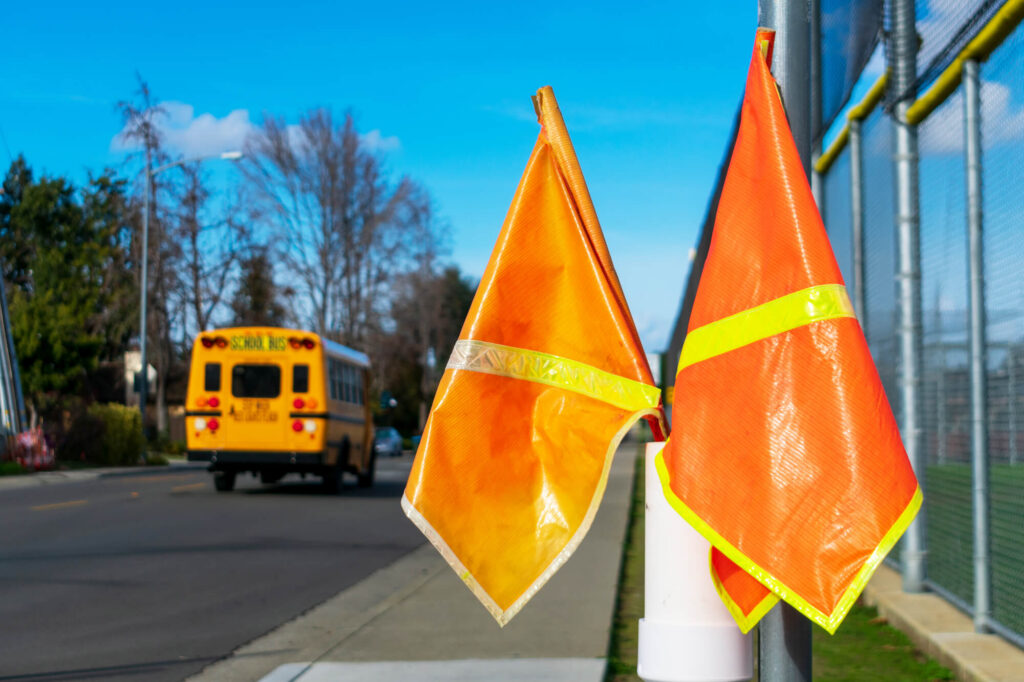
When an authorized traffic or crossing guard enters the road or displays a stop paddle or other similar portable signs, your teen should stop with enough space and follow the guard’s lawful directions. They should remain stopped until the traffic guard signals traffic to continue and the crossing path is clear.
Bikes, Scooters, and Parked Cars
Near schools, kids on bikes, scooters, and skateboards may wobble, ride in groups, or make sudden decisions. Add poorly parked vehicles, and movement can easily become hidden.
Your teen should assume that any gap near a school could conceal a pedestrian or rider.
Help your teen avoid three high-risk moves:
- Never squeeze past a bicyclist or scooter rider near parked cars or a crosswalk.
- Never stop on a crosswalk or block a curb ramp, even in slow traffic.
- Never trust an open gap between parked vehicles without reducing speed and scanning carefully.
Poor parking can block sight lines and hide children from view. Your teen cannot control where other drivers stop, but they can control their own speed, space, and scanning.
That is pattern recognition: noticing where hidden movement is likely and preparing before someone enters the roadway.
When You Must Stop for a School Bus in a School Zone
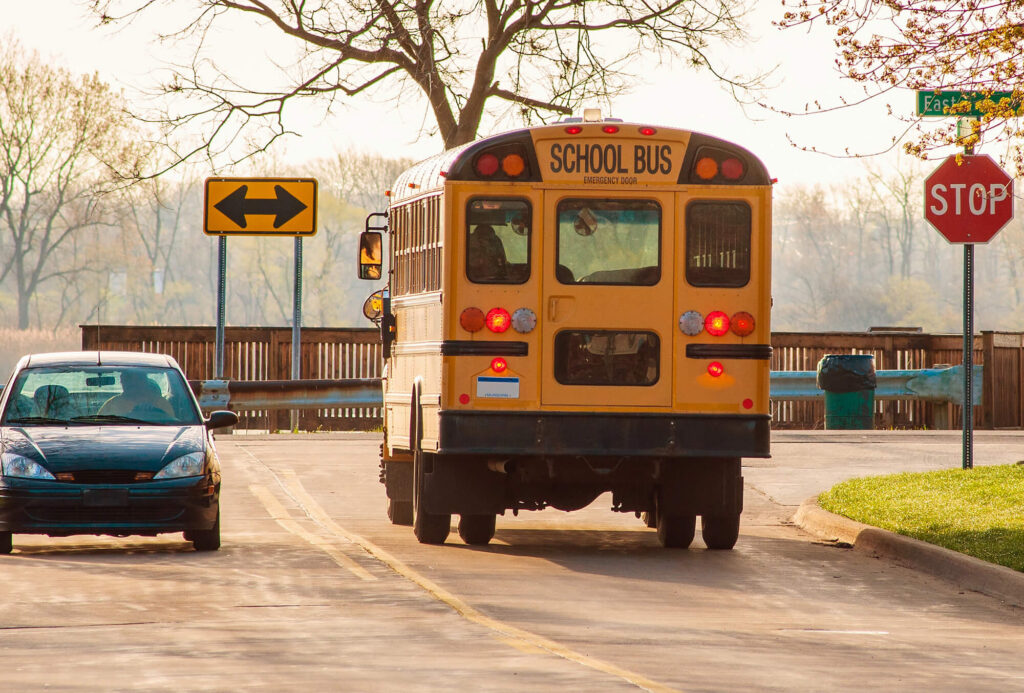
The key school bus rule is simple: when a school bus displays flashing red lights and an extended stop arm, drivers must follow the stopping requirements in their state.
School bus laws vary significantly. The rules may depend on:
- The number of lanes
- The direction of travel
- The presence and type of median
- Whether the road is divided or undivided
- The state in which the driver is operating
Many state driver handbooks follow a pattern similar to the one below, but this table is not a universal statement of law.
| Road type | Divider present? | Common stopping pattern* |
| Two-lane or undivided road | No | Traffic in both directions may be required to stop |
| Multi-lane undivided road | No | Traffic in all lanes and both directions may be required to stop |
| Divided highway with a qualifying physical median | Yes | Opposing traffic may be exempt in some states |
*Always confirm the rule in your current state’s driver’s handbook. A painted center turn lane or painted divider may not qualify as a physical median.
When stopping is required, your teen should leave the distance required by state law and maintain a clear safety buffer around the bus. Children may cross in front of the bus, approach from the opposite side of the road, or appear from an area the bus has blocked from view.
Your teen driver should remain stopped until the legal conditions for proceeding have been met. Depending on the state, that may include the red flashing warning lights turning off, the stop arm retracting, children clearing the road, or the bus beginning to move.
The safest habit is not to guess.
Learn the state rule before driving the route, and when an active bus creates uncertainty, slow down, stop when required, and wait until proceeding is clearly legal and safe.
How Lane Changes, Turns, and Passing Work Inside School Zones
Even at low speeds, sudden movements can turn a busy school zone into a dangerous situation. Inside an active school zone, the safest rule of thumb is: no surprises.
That means avoiding unnecessary passing, last-second lane changes, and abrupt turns near children, buses, pedestrian crosswalks, or school driveways.
Passing and U-turn laws vary by jurisdiction. Drivers should always follow posted restrictions and local law. Even when a maneuver is technically allowed, it may not be the safest choice in a crowded school environment.
Help your teen treat school zones as areas for calm, predictable movement:
- Avoid passing when visibility is limited, or children may be present.
- Avoid U-turns and last-second turns near school driveways, crosswalks, and side streets.
- Move into the correct lane early, before bus loops, parking lots, or pickup lanes.
- Signal with enough notice for other drivers and road users to understand the vehicle’s path.
- Leave extra following distance so braking can remain smooth and controlled.
School entrances, bus-loading areas, parking lots, and side streets create conflict points where the paths of vehicles, bicyclists, and pedestrians may cross.
A sudden lane change at one of these locations can increase the risk of a sideswipe or angle collision. Staying in one lane gives everyone more time to see children, guards, buses, and turning vehicles.
This is space discipline: maintaining a stable path and preserving enough room to react without making an abrupt move.
Distraction-Free Driving and Visibility Around School Pickup and Drop-Off
Most teens know they should not text and drive, but they may underestimate how quickly school zone distractions can stack up.
Phones, group chats, loud music, navigation changes, and joking with passengers all pull attention away from the road at a time when children, buses, and vehicles may be moving in several directions.
Phone and distracted-driving laws vary by state, particularly for drivers with learner permits or provisional licenses. The safest standard is to remove avoidable distractions before the vehicle begins moving.
Your Phone, Passengers, and “School Zone Mode”
Give your teen a simple “school zone mode” for the vehicle so there is no debate in the moment.
The goal is to make safe behavior automatic before the teen reaches the school.
- Put the phone on silent and out of reach before moving.
- Do not text or scroll, even while stopped at a red light.
- Keep conversations calm and avoid loud activity inside the vehicle.
- Set the route, audio, and climate controls before driving.
Pair that with a three-point scan as your teen approaches a school: Sidewalks. Parked vehicles. Bus stops or driveways.
Their eyes should sweep those three areas instead of locking only on the vehicle ahead.
If the area uses speed-display signs, treat them as early reminders to check speed and scanning, not as last-second warnings.
Low Sun, Rain, Fog, and Darkness
Morning and afternoon school traffic often coincides with low sun, wet pavement, fog, snow, or winter darkness.
In poor visibility or reduced traction, the safest move may be to drive below the posted school zone limit in a drop-off zone or nearby while maintaining a safe and reasonable speed for conditions.
Your teen should:
- Increase the following distance.
- Turn on the appropriate vehicle lights.
- Clear windows and mirrors before moving.
- Avoid sudden steering or braking.
- Expect children, bicycles, and crossing guards to be harder to see.
- Reduce speed before entering the most congested area.
The number on the speed limit sign is a maximum under appropriate conditions, not a required target. A teen who can explain why they chose a lower speed in poor conditions is showing real defensive-driving judgment.
How to Use a Simple “Spot, Slow, Scan” Framework in Any School Zone
Your teen does not need to memorize a dozen separate tricks or every single traffic rule to avoid a traffic violation ticket, a license suspension, or worse.
A simple three-step habit—Spot, Slow, Scan—can cover nearly every school zone situation and give parents and teens a shared coaching language.
The idea is to spot the zone early, slow down before reaching it, and keep scanning until the vehicle has completely exited the area.
Spot, Slow, Scan in Three Moves
Spot, Slow, Scan turns school zone driving from “winging it” into a repeatable routine.
Saying the steps aloud during early practice can help your teen remember the sequence until it becomes a consistent habit.
Step 1: Spot the Zone Early
Look ahead for school zone signs, flashing lights, buses, crossing guards, crosswalks, and groups of children before reaching the active area.
Step 2: Slow Before You Reach It
Ease off the accelerator so the vehicle reaches the required speed before entering the zone or passing the point stated on the sign.
Avoid waiting until the vehicle is already inside the zone to brake.
Step 3: Scan Constantly
Keep the eyes moving across sidewalks, parked vehicles, crosswalks, bus stops, driveways, and side streets until the vehicle has completely exited the zone.
Practice saying “Spot, Slow, Scan” during supervised drives until the process feels natural.
Parents can ask:
- “Where does the school zone begin?”
- “When are you starting to slow?”
- “What areas have limited visibility?”
- “What are you scanning for?”
- “Where is your open space?”
These habits protect children, support better road-test performance, and help teens develop the calm alertness needed for everyday driving.
Turning School Zone Rules Into Real-World Confidence for Your Teen
Knowing the rules is one thing. Staying calm and consistent when buses, parents, pedestrians, and vehicles are all moving at once is another challenge. That is where structured practice matters.
The more your teen drives familiar school routes with clear, calm coaching, the less those environments will feel like chaos and the more they will feel like another manageable part of the drive.
Start by letting your teen drive past the school at a quieter time or outside of the normal school year.
Use the opportunity to identify:
- Where the school zone begins and ends
- Where the signs are located
- Which crosswalks have limited visibility
- Where buses load and unload
- Where vehicles commonly stop
- Which lanes lead to school entrances
- Where bicyclists and pedestrians may enter the road
Once the route feels familiar, practice during progressively busier periods when it is safe and appropriate to do so. Use Spot, Slow, Scan as your shared language, and debrief after each drive:
- What felt controlled?
- What felt rushed?
- Which hazard appeared early?
- Where could more space have helped?
- What should be repeated on the next drive?
Treat mistakes as correctable skill gaps rather than personal failures. Calm repetition builds confidence more effectively than criticism.
From School Zone Rules to Real-World Readiness
School zones test whether a teen can recognize hazards early, manage space, and make calm decisions in a fast-changing environment. That is why Spot, Slow, and Scan matter. With practice, it becomes a repeatable habit to maintain a Survival Zone and respond with control rather than react late.
Those are the habits Jungle Driving School works to build through structured instruction, patient coaching, parent involvement, and real-world defensive-driving practice. The Jungle Way prepares teens for more than the driving test by helping them develop the confidence, awareness, and judgment they will need every time they get behind the wheel.
Because passing the test is only the beginning, the real goal is helping your teen become a safer, more prepared driver for the road ahead.
Find a Jungle Driving School location near you or contact us to get started.
from Jungle Driving School https://ift.tt/sDBGeHg
via IFTTT


Comments
Post a Comment